|
|
STORE HOURS
Mon-Sat: 9am-6pm
TASTING ROOM HOURS
9am-5:45pm
Closed Sundays |
Prices Posted on our site are
subject to change without notice.
We are seeing our trade partners
increasing prices at a fast & furious rate.
(They're Fast and we're Furious.)
| |
Wines for The Adventuresome
We like discovering new
wines...interesting and unusual wines made from grape varieties that are
a bit "off the beaten path."
Most stores selling wine stick to wines for which there's already a
demand, so they don't have to "show & sell."
Most places, further, don't even make an effort to guide consumers to
good, soulful wines. It's easier, frankly, to simply post a
numerical score and let folks fend for themselves.
One chain of stores even has its own wine guru who bestows 90 point
scores on wines.
What a sick way to buy or sell wine!
Given that most critics use "Cabernet Sauvignon" as a
yardstick, how can they possibly taste and appreciate a wine made of
Charbono, Tocai Friulano or Zweigelt?
Well, if you can break away from the mainstream, I promise that you'll
find some really interesting wines and, frequently, good values, too. |
-
-

- POJER e SANDRI 2024 NOSIOLA Vigneti delle
Dolomiti $24.99
The Nosiola grape is particular to Italy's Trentino region, north
of Verona and south of Bolzano.
The origins of this variety are not well known and there's not much
Nosiola to be had as there are but 70 hectares in the Trentino region.
Some claim the name of Nosiola stems from the Italian word for hazelnuts,
Nociola.
This variety is usually made, these days, as a dry white. But it can
be made into a sweet wine from grapes that are dried, making a Trentino
Vino Santo.
We're told this rarity stems from all of 5 hectares of vines.
Pojer e Sandri make a small amount of a lovely dry white wine from Nosiola
grown high in the hills of Trentino near their winery in Faedo.
It's light and crisp with some green apple fruit. Some tasters
describe this as a bit Chablis-like.
We don't find the flinty notes, but it does have a mild minerality
to it.
Nosiola can be paired with all sorts of light or mild seafood dishes.
Does it display a character with a note of hazelnuts to it?
Buy a bottle and you can decide for yourself.

-
-

-
-
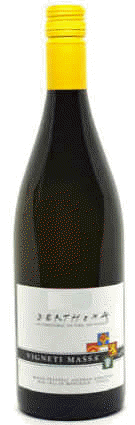
VIGNETI MASSA 2023 TIMORASSO
"Derthona" $42.99
The Massa family vineyards are near the Italian town of Tortona.
The family used to cultivate a lot of Cortese grapevines but they had some
other sites with mixed plantings. Cortese made a fairly neutral dry
white and Walter Massa knew they had some other varieties on their estate.
In 1987 he poked around and identified vines of the Timorasso variety, a
once prominent variety, but not the easiest to grow.
He harvested enough to make roughly 500 bottles and he was encouraged by
the results.
Over the years his wine gained a measure of critical acclaim and these
days he's regarded as "the father of Timorasso."
We understand there are currently about a hundred winemakers vinifying
Timorasso and a number of high profile Barolo and Barbaresco vintners are
making this.
-

-
-
-

Massa's remains a reference point and we currently have his 2023 in the
shop.
It's nicely intense and dry...there are some peach and apricot notes and a
light astringency on the palate. This is delicious right now and
it's a wine that can be cellared for a number of years, though it tastes
so good now, why hold onto it?
This is well worth putting on the table!
-

CEDARVILLE El Dorado County VIOGNIER $24.99
The Viognier grape finds its home in France's Rhône Valley where
the appellation of Condrieu is located. Nearby to that area there's
a wine with its own appellation called Château Grillet and it, too, is
entirely Viognier.
The grape was adversely impacted in the late 1800s when the root louse
called Phylloxera wreaked havoc on the vines.
Things were not much brighter with a World War, or two.
Demand for Viognier was low into the 1960s and 1970s.
A few enterprising winemakers were curious about this variety and in the
1980s planting increased in France and they started to take hold here in
California, too.
These days there are close to 2400 acres in The Golden State.
Chardonnay plantings are roughly 35 times more plentiful than Viognier!
The grape likes granitic soils and winemaker/wine-grower Jonathan Lachs
has such terroir in his Sierra Foothills vineyards.
His Cedarville Viognier is routinely excellent!
The wine is vinified in a mix of stainless steel and seasoned oak
cooperage, creating a remarkably complex bottle.
Unfiltered.
It displays the classic peach and apricot notes we like in some French
bottlings.
It's dry and shows nice acidity giving the wine its vitality.
Jonathan suggests pairing this with spicy seafood, shellfish and what he
calls "bombastic cheeses."
We've enjoyed it with seafood.
Damned good.
-
-
-
-
-
-
-
ABACELA
 The
Abacela story is remarkable and it centers on two hardy souls who enjoyed
the budget-priced wines they could afford from Spain. The
Abacela story is remarkable and it centers on two hardy souls who enjoyed
the budget-priced wines they could afford from Spain.
Earl & Hilda Jones (that's their real names, not something from the
Witness Protection Program) lived in the Gulf Coast and were perplexed
that the grape responsible for the wines they loved so much from Spain,
Tempranillo, was not much of a presence anywhere in American wine
regions. This, of course, was back in the late 1980s and early
1990s.
Mr. & Mrs. Jones began studying climate way back when and it helped
that their son Gregory is a climatologist and researcher who's now working
at Southern Oregon University. Dr. Jones was on the road
to working in the culinary world before his parents' interest in
grapevines got him headed in a different direction.
They chose an un-tested region and began planting Tempranillo in
Oregon's Umpqua Valley, a place that was just starting to simmer with
winegrowing activity.. In fact, the word "abacela"
translates from some old Iberian language indicate the planting of a
grapevine. And plant they did, indeed!
Today they have 10 clones of Tempranillo scattered around 27 acres of
vineyards. And the vineyard sites are geologically quite
diverse.
The Jones family makes several Tempranillo wines. We currently have
their "Fiesta" bottling, a sort of entry-level wine which is
actually quite good. We were a bit surprised to find this wine hits
so many of the notes we appreciate in good Spanish wines.
It comes from their Faultline Vineyard and this is a remarkably diverse
site. Diverse in terms of elevation and slope, as well as
terroir.
Anyway, the 2019 Fiesta is quite good...it's along the lines of
a good Crianza wine from Rioja, but perhaps a tad fuller in body, so comparing
it to a wine from Ribera del Duero is not much of a stretch, although it's not
one of those high alcohol, heavily extracted sort of wines.
The wine saw 63% French oak and 37% American barrels with a bit more new oak
this vintage than in the past. We like the hint of oak in this wine...it's there just so you can
sense it, but not so much that it's all you smell or taste.
The wine is nicely gentle on the palate and it's even smoother paired with
paella, lamb or well-seasoned roasted chicken.
They also make a sweet, fortified wine they label as "Port," much to
the chagrin of wineries in Portugal's Douro Valley.
It comes in half bottles and it's a blend of Tempranillo, Tinta Amarela, Touriga
Nacional, Tinta Cão and Bastardo. It displays some dark berry notes with
a touch of a raisiny note. They make this along the lines of Vintage Port
rather than Tawny.
Best at cool cellar temp.
The beautiful label was designed by Hanna Jones when she was a
kid. She's still young, actually, but she's an interior
designer these days.
-
Currently in stock: 2019 ABACELA "Fiesta"
TEMPRANILLO $26.99
ABACELA "PORT" $26.99 (375ml)


-
BOUZA 2019 TANNAT Reserva $24.99
BOUZA 2017 TANNAT "B6" $44.99 (Sold Out Presently)
- The Bouza family took over an old winery located maybe 20-30 minutes'
drive from Montevideo in Uruguay. They make quite a range of wines,
both white and red.
Uruguay, though, is noted for its work with the Tannat grape, a variety
whose home is in France's southwest. The wines of Madiran can be
styled along the lines of those from nearby Bordeaux, though not made
primarily of Cabernet or Merlot.
We have often found the Tannats from Bouza to be quite good.
Currently we have their 2019 vintage Reserva bottling. It's a
medium-full bodied red with some dark fruit character and a sweet, woodsy
character. The tannin level is modest, making this quite drinkable
in its youth.
You'd serve this in place of a domestic Cabernet or Merlot, for
example.
More profound and beautifully charming is their 2017 bottling labeled as
"B6."
We're told they make less than 400 6pks of this single-vineyard
wine. It comes from a parcel of vines known as "Las Violetas."
It's intense in color and shows lots of dark fruit notes with a nice
balance of oak. We find it drinkable now, but it does have a mildly
tannic backbone which should allow it to age handsomely for five to ten
years. Pairing it now, though, with a good steak or lamb will cut
through the tannins.
-
-


TRUCHARD 2024 ROUSSANNE $27.99
The Truchard family hails from France, coming from some
isolated place not far from Lyon.
They ventured to Texas and two Truchard brothers took up growing grapes and
attempting winemaking in the environs of Houston.
Prohibition in the US made that an overwhelmingly impossible task. Add to
the mix the challenges of growing grapes in the oppressive heat of Texas.
Jean-Marie Truchard's grandson Tony was born in Texas and wanted to escape the
family business which was cattle ranching, so he got off the farm and went to
college, studying medicine. He met the love of his life in the early 1960s
and after medical school he registered for the U.S. Army in an effort to pay off
his student loans.
The couple and their growing family were supposed to take an Army transfer to
Korea, but Mrs. Truchard broke her knee grocery shopping and close to delivering
their fourth child.
His commanding officer thought better than their Korea dispatch and sent the
Truchards to a remote outpost some 50 miles north of Reno, Nevada.
Having a meeting with military brass in San Francisco, the Truchards drove back
home (Herlong, California!) through Napa.
Tony Truchard was intrigued by the sight of so many vineyards that thought to
buy some property in what we know as the Carneros region.
Experts in that era told him the area was too cold to ripen grapes. Add to
the challenges the lack of water for irrigation to establish vineyards.
With a soil expert Truchard was able to plant vines being one of the early
pioneers with drip irrigation and he was off and running.
Since his first foray with grapes planed on 20 acres, he's now amassed something
like 400 acres with 280 planted.
They sell most of the fruit but in 1989 they vinified a few things and in 1998
took the full plunge by building a winery.
Truchard now cultivates a dozen different varieties and their name was often
seen on prestigious bottlings from Napa and Sonoma wineries who had purchased
fruit.
We've found Truchard's own wines to be good quality and elegant.
They have an exceptional Roussanne these days as they planted three acres of
that Northern Rhône grape.
The bunches are whole cluster pressed and the juice goes into French oak for its
fermentation. Roughly 20% of the barrels are new so the resulting wine has
some elements of complexity from its exposure to wood. We appreciate that light
touch of seasoning as the wine is, for our tastes, not overtly oaky.
We find notes of apples and pears and maybe a light brown spice tone...cinnamon,
perhaps? Or is that nutmeg??
It's dry and medium bodied. Good as a cocktail white but even more
satisfying with white fish, crab, prawns, etc.
And the price is right in our view.

-
VON WINNING 2020 SAUVIGNON BLANC
I $47.99
- You're probably wondering why we'd include a Sauvignon Blanc on a page
featuring "adventuresome" wines. After all, Sauvignon
Blanc is a mainstream grape variety.
But few people expect to find grand Sauvignon Blanc in Germany!
There are some really good German Sauvignons, though, but there's only one
Von Winning I. (They make a Von Winning II, by the way.
There's also a Von Winning Sauvignon 500 that is quite a bit more costly
and quite good.)
When it's first released the wine displays intense Sauvignon fruit and
there's a fair bit of oak. The wine is easily compared to the top
bottlings of white wine from Bordeaux's Pessac-Léognan region. With
a bit of time in the bottle, it takes on a more floral aspect. We
inquired as to whether or not they blend in a bit of Riesling, as German
wineries need have 85% of the particular grape variety on the label be in
the bottle, so there is room for some blending leeway. Of course
they claimed it's entirely Sauvignon Blanc.
The wine is stellar, though and remarkably stylish. We've served a
number of bottles and knowledgeable wine aficionados never guess it's a
wine from Germany.
There's citrusy Sauvignon and a lavish level of oak (ever had Smith
Haut-Lafitte?). The wine is dry and has a good level of acidity,
too. You'll find it fairly full-bodied.
-

-


-
SOALHEIRO 2024 ALVARINHO $26.99
- Almost every year we bring this wine to a dinner held for the judges at
the San Francisco International Wine Competition. And each year we
see the judges who have a sniff and a taste of this reach for the
smart-phone to take a snapshot of the bottle.
For the 2019 Judge's Dinner we brought a rare format, a 3 liter
bottle! We were able to share it with more of the judges (there are
50, or so people here from all over the world).
We had discovered this wine on a trip to Portugal more than 25 years ago. We were dining in an old-time seafood restaurant on the
Atlantic Coast and had ordered a very modest bottle of Vinho Verde as the
restaurant had been suggested by a guy whose family makes a lot of
popularly-priced wines. We paid 8 Euros for a bottle of his
wine. Having drained that bottle with the first courses, we asked
the waiter if he might suggest something seriously good and
well-priced. He brought us a bottle of Soalheiro Alvarinho.
They make a few higher-priced bottlings and we do like the "Primeiras
Vinhas" Alvarinho. It's made of older vineyards.
But the "regular" bottling of Alvarinho (Albariño in Spain) is
fantastically good. There's a mildly citrusy element to the wine and
we love the stony aspect we encounter on the palate. It's simply
damned good. Soalheiro's is one of those special wines that makes
you take notice.


- DOMAINE ILARRIA 2016 IROULEGUY $24.99
- The vineyard
land in this south-west appellation struck me as rather rugged, perched on
steep hills and worked by rugged individuals. I suppose it's little
wonder, then, that the wines of the Irouleguy area are some of the most
"sturdy" in France and they're a galaxy apart from today's modern,
internationally-styled wines so prevalent thanks to point-counting
world.
-
You're in the Pyrénées and Basque Country when visiting producers of
Irouleguy. The language is different, the people are wonderfully
different and the wines, thank goodness, are different.
-
-

Domaine Ilarria is owned by Peio Espil, one of the top vintners in the
region, not that there are hundreds. In fact, most of the wine of the
appellation is made by the local growers' cooperative. Most of the
production from the region stays at home...only 10% is exported. But
then, when you think about it, not many foreigners probably have a palate to
appreciate this sort of wine. They make a rosé, for example, which is
screamingly dry and tart.
Here's a wine based on the Tannat grape that's "tempered" with
Cabernet Franc (yikes!), so it pairs well with red meats, duck, etc.
The word "austere" comes to mind as a good descriptor. I
like the 2016 from Ilarria. It's medium-full-bodied, moderately herbal and I found
the Cabernet Franc to give much of the aroma in this wine. If you're a
fan of Madiran and Cahors wines from the Southwest, you might consider
trying a bottle of Irouleguy.

-

Mrs. Espil.
-
-

American wine geeks visiting the Ilarria cellar.

Peio Espil in explains cultivating Tannat and Cabernet vines in Basque
Country. The vines, just 6 miles from the Spanish border, are
cultivated organically because Espil says the indigenous yeast on the
grapes is 'stronger' or more capable of a complete fermentation.
Yields are rather small in an effort to maximize quality.

An old vintage of Ilarria...
-

Here's an antique bottle of Irouleguy...a 1928!

A Basque Stew to pair with their formidable Irouleguy.

-
\
-
-

-

As you can see, the elevation at Colomé is quite high...
They have vineyards in several locations, ranging from 5,740 feet on the low
end (!) to 10,200 feet at the highest place.


-
-
BODEGA COLOMÉ 2024 TORRONTES $13.99
-
- This old, pioneering Argentinean winery was purchased by Donald Hess
(The Hess Collection in Napa)...it's said to be the oldest winery in
Argentina.
These days it's owned by the late Swiss wine magnate Donald Hess's
heirs. His
Napa winery, "Hess Collection," has a lovely little museum
with interesting and creative art on display.
Similarly, Colomé has a museum featuring the work of an American
artist named James Turrell, a fellow who's been a National Medal of
Arts award winner. He's quite skilled in featuring light and
space in his creations, but also has an ongoing project outside
Flagstaff, Arizona called the Roden Crater.
Hess has been a longtime fan of Turrell's work.
- The winery makes a range of wines...we've been fans of their white
wine more than the assorted reds.
We view the Colomé Torrontes as the benchmark example of this
grape. The folks at this winery credit the high elevation and
intense ultraviolet light with helping to produce this remarkable
wine.
Their theory is that the intensity of the UV rays causes the grapes to
develop a thicker and darker colored skin.
I don't know if that's why this wine is so magnificently
aromatic and flavorful or if it's the particular clone of
Torrontes. But whatever it is, this wine is remarkable.
The fragrance is detectable the moment you open the bottle...there are
fragrances of exotic fruits and a bouquet of intensely perfumed
flowers. Despite all these "sweet" elements, the wine is
actually quite dry.
- If you're looking for an amazing aperitif wine, consider this.
It also pairs well with that Avocado/Mango 'salad' you're pairing with
pan-roasted Sea Scallops...
-
-
-

TIEFENBRUNNER MÜLLER-THURGAU "Feldmarschall von
Fenner" Sale $64.99
This extraordinary dry white comes from vineyards high in the
Dolomites...Italy's Alto Adige and, in this case, quite "alto."
The grape was a crossing of Riesling and Madeleine Royale, created by a
Swiss fellow named Hermann Müller in the late 1800s when he was working
in Germany at the Geisenheim Grape Breeding Institute.
Christoph Tiefenbrunner has less than 8 acres planted of this and his
deluxe bottling is a benchmark for Müller-Thurgau as yields are
relatively modest and his vineyard site is ideal for this grape.
He ferments half in concrete and half in large wooden vats which are
fairly neutral, so wood is not part of this wine's makeup.
The fermentation takes place with indigenous yeasts and the wine stays on
the fine lees for close to a year.
It's beautifully intense and remarkably complex.
Some Trentino friends make Müller-Thurgau and I opened a bottle of this
when we were enjoying a dim sum meal in San Francisco.

Theirs is pretty good, but it's a lighter rendition.
This displays remarkable aromatics with some flowery notes and ripe melon
and peach tones.
The flavors are quite lengthy and it's a most satisfying white with the
Asian seasonings.

ONCE & FUTURE 2022 Contra Costa County MATARO Oakley Road
Vineyard $26.99
Winemaker Joel Peterson was once a partner (and winemaker) at a little
start-up called Ravenswood Winery which was launched in 1976.
Over the years it grew ginormously. When the investors in the enterprise
wanted to cash out, they did en masse, with only Peterson voting not to
sell the business to Constellation Brands.
Constellation held the brand for 20 years and in 2021 sold it to Gallo.
So Peterson launched a new label with a design somewhat similar to the
art on bottles of Ravenswood.
Once & Future, a reference of course to his early winemaking days and for
what's to come.
We've enjoyed a number of his new wines and one that is showing well for
both quality and value is a Mataro from Contra Costa County.
It comes from the Oakley Road vineyard and those Mataro vines are 122
years old.
In the warm 2022 growing season the fruit ripened around mid-August and
it's nicely balanced being a medium-full bodied red showing a bit of dark berry
fruit along with a slightly earthy note and some spice.
Quite drinkable now, it may develop additional complexity with several
more years of bottle aging, but we find it tasty in its youth.
More exuberant in terms of fruit than many Bandol reds.


-
MORE
ADVENTURESOME WINES

|


