|
|
STORE HOURS
Mon-Sat: 9am-6pm
TASTING ROOM HOURS
9am-5:45pm
Closed Sundays |
Prices Posted on our site are
subject to change without notice.
We are seeing our trade partners
increasing prices at a fast & furious rate.
(They're Fast and we're Furious.)
| |
California Pinot Noir Page 1
CALIFORNIA PINOT NOIRS

Having its home in both Burgundy and Champagne, Pinot Noir
has been in California for many years, probably since the late 1800s. It is a fussy
and finicky grape variety, prone to genetic changes which means there are many
"clones" of Pinot Noir.
The grape tends to produce wines which have much less color than Cabernet or Zinfandel,
for example. I have seen, in many tastings, wines which are color-poor, but,
curiously, have the most intense fragrance. Tasters are frequently swayed by
the color and appearance of a wine and cannot credit a weakly colored wine with having
more intensity to its "nose" than deeper colored/less fragrant wines.
Another feature of Pinot Noir is it displays character according to its vineyard
site.
The differences in Cabernet Sauvignon grown in fairly close proximities might
not be detectable to the average consumer, but Pinot Noir grown in neighboring
vineyard sites can be dramatically different.

Back in the 1960s and 1970s, we'd routinely hear how Pinot Noir was
not well-suited to cultivation in California and the wines did not resemble
French red Burgundy at all.
Yet it was not uncommon for California winemakers to "fortify" their Pinot
Noirs with something such as Petite Sirah or Zinfandel. The wines had great color and, perhaps, a
bit more body and tannin, but the peppery Petite Sirah or spice notes of
Zinfandel detracted or overwhelmed the subtle
and delicate cherry-like Pinot Noir fruit.
Curiously, in France's Burgundy, it was
said vintners or negociants routinely beefed up their wines with some deeper red from the
south of France (or Algeria, which was a major wine-exporting region
once-upon-a-time!). A Burgundy house was discovered (a few
years ago) to have been selling wines illegally blended with stronger red wine
from outside the appellation. (Quel surprise!)
The temptation is great to make beefier wines, as critics and their audiences,
often find "bigger is better."
I am certain some local vintners still adulterate (or "enhance," depending upon
one's perspective) their Pinot Noirs with darker, stronger varieties. One prominent
winery owner chided me for even asking such a question, though he would not declare
that his wines were 100% Pinot Noir!
It seems that Pinot Noir varies according to clone, soil, exposure, climate and
we haven't even discussed vinification. Many Burgundy winemakers will tell
you their wine does not reflect the Pinot Noir grape, but instead the grape
reflects the terroir.
Some producers will tell you the juice
should be kept at a cold temperature (which inhibits fermentation) and macerated on the
skins for a week before fermentation is initiated. Other winemakers say this is a
recipe for disaster. Some winemakers claim to ferment with the stems, while others
say this is not the way to make good Pinot Noir.
As you can understand, controversy abounds!
 The
aromas of Pinot Noir vary as a result of so many of the factors enumerated above. We
prefer to find bright fruit aromas, reminiscent of cherry or strawberry. We like a
bit of vanillin from the oak. The
aromas of Pinot Noir vary as a result of so many of the factors enumerated above. We
prefer to find bright fruit aromas, reminiscent of cherry or strawberry. We like a
bit of vanillin from the oak.
Some Pinots have a gamey quality to them. In his
book entitled "BURGUNDY" by Anthony Hanson, this expert writes "Great
Burgundy smells of shit. It is most surprising, but something the French recognized
long ago, a sent la merde and a sent le purin being common
expressions on the Côte. Not always, of course; but frequently there is a
smell of decaying matter, vegetable or animal, about them. This is nothing
new."
Uh, well, we prefer the cherry and berry notes, thank you!
Years ago, there was a school of thought which felt that California was too hot for Pinot Noir. Oregon enjoyed
some notoriety as experts wrangled over which area was producing the best West Coast
Pinots. An east coast tasting, written about in the New York Times (some years ago,
now) said the favored wines were Oregon and Burgundy when tasted with the labels exposed.
When the wines were poured for a blind-tasting, California won.
Today's wine critics are having an impact on Pinot Noir production. Since
the dynamics of most blind tastings (and tastings that are not
"blind") is to find the biggest and most intense wines, Pinot Noirs of
elegance and refinement are marked down as thin and light, while wines with
Syrah colors and Cabernet tannins are now often garnering the highest scores.
Pinot Noir winemakers are, it seems, interested in picking Pinot Noir as ripe as
possible. One vintner told me the trend is to harvest the fruit when it's
close to 16 to 18 percent "potential alcohol." Then water is
added to the juice and the fermentation ensues. I am not sure what
benefits are obtained by picking at this high level of sugar, but it seems to be
popular amongst the young winemaking crowd.
The high ratings encourage consumers to buy these sorts of wines and it encourages
winemakers to produce this style of Pinot.
We have noticed the
alcohol levels of Pinot Noir are often pushing 14% to 15%, sometimes even
more! It's not about the alcohol, though. It's about
"balance." Some wines can still be balanced and delicious at a
high octane level, while others can be totally out of whack.
We have had some Pinots which were made from such over-ripe fruit,
the wines resemble late-picked Zinfandel. One even has scored in the
mid-90s from a prominent critic despite the wine having little in common with
Pinot Noir.
There's an awful Pinot that receives high praise from various
publications. We've had four vintages in tastings and the wine routinely
finishes in last place. All we can figure is the winery sends in samples
of someone else's wine (probably French Burgundy, since it is often described as
being reminiscent of Grand Cru level wines) and they bottle plonk to sell to
consumers. If the
wine they send to critics is the same as what they sell, this calls into
question the expertise of those writing about wine.
Anyone who claims to be a Pinot aficionado and who tastes California wines such as
The Ojai Vineyard, Dehlinger, Patz & Hall, Walter Hansel, Rochioli, Merry
Edwards, Kistler (etc.) who says these are not good wines simply doesn't
understand the subject.
SOME PINOTS WE LIKE:
-

-

- TOMAQ WINES
- This small winery is the work of a one man band, a fellow named Matt
Towers.
We first met Matt ages ago when he worked for a small Marin County wine
importer. They featured French Burgundies and maybe a winery from
Alsace.
He later worked in high tech before the wine bug bit him again. Soon
he was vinifying a few tons of fruit, making and bottling his own wines.
Pinot Noir.
He gets grapes from foggy sites on the Sonoma and Mendocino coast.
Tomaq is from the Kashaya (Pomo Indians) word for fog.
Matt made a couple of Rosé wines and a couple of reds and as he's realized
making wine is a challenge, it's an even bigger task to sell them.
Even when the wine is really good.
The 2021 comes from Mendocino's Manchester Ridge vineyard. Some whole
clusters were in the fermentation tanks and then the wine was matured in
something like 30% new French oak, giving it a kiss of sweet wood.
This is a medium-boded, elegant Pinot Noir that's quite showy, especially
given it's well-priced. $48 from the winery and we sale-tag it at
$39.99.
Matt's not making more wine as the job requires too much time on several
levels, so we're sad to lose this place as a source of good wine.
I'm pretty sure Weimax has been a major ambassador for Tomaq wines.
Not long ago two French women ventured in, having come
to Broadway in search of lunch one day on their California
vacation. They ambled into Weimax and poked around for a few
minutes. We asked if they needed help making a selection and the
one who spoke a bit of English said they're here from Burgundy, saying
we're probably not heard of their home town,
Chambolle-Musigny.
Ha!
I showed them a few snapshots of a visit to Burgundy.
Then, as we had a bottle of Tomaq Pinot Noir open, I offered to pour
them a sip of wine.
As they sniffed the wine they were speaking in French about how this
was le vrai Bourgogne.
I encouraged them along this path until I put the bottle of Tomaq
Pinot Noir on the counter and they both gasped in horror as here was a
wine which was so familiar to each of them and yet so foreign also.
Happily they purchased a few bottles to take back home to fool their
friend in France! |
- Currently in stock: TOMAQ 2021 Mendocino PINOT NOIR
Sale $39.99
-


WALTER HANSEL WINERY
The Hansel name in Sonoma is rather famous, but
more for automobiles than for wine.
We might say that's changed over the past two decades as many people, especially
those in the wine world, associated the Hansel name with good Pinot Noir and
Chardonnays more than they do Fords, Mazdas and Subarus.

Walter Hansel, you see, made his money in selling and servicing cars.
His son Stephen has been more interested in the wine world.
From a small "garden" of 250 grapevines, they currently farm something
like 80 acres of Pinot Noir and Chardonnay, making some brilliant
Burgundian-styled wines.
The winery website claims they have 11 clones of grapes between Pinot Noir and
Chardonnay and then says there are 6 clones of Pinot Noir and 7 of Chardonnay.
We are uncertain how those two figures account of 11 clones, but maybe it's safe
to say they're more competent in growing grapes and making wine than they
are in mathematics.
They began making wines in the mid-to-late 1990s and these days they're said to
produce a good quantity of wines.
There are some single vineyard bottlings and we have found these to be
remarkably consistent (and good!).
We currently have their 2023 vintage of Cahill Lane Pinot Noir. It's
comprised of three clones of Pinot Noir and has some dark cherry fruit and a bit
of toasty oak.
Medium-bodied and ready to drink in its youth.
Currently in stock: WALTER HANSEL 2023
Russian River Valley PINOT NOIR $46.99

-
-

-
-
-
-
-
GARY FARRELL
- Gary Farrell
was a political science back in the 1970s at Sonoma State University.
With the Russian River Valley in the vicinity, Farrell got sidetracked
thanks to fellows such as Tom Dehlinger, Davis Bynum and Robert Stemmler.

We recall Stemmler being a consultant to other wineries in addition to making
his own Pinot Noir,
which we rarely found to be particularly attractive.
-
-
- After a number of years of being a cellar rat, Gary took an official job as
winemaker for the Davis Bynum winery. In the ensuing years, he also
launched his own label, trading winemaking work for grapes.
His Pinot Noirs were much sought-after and the wines were of good
quality. He made Sauvignon Blanc, Zinfandel and Chardonnay, but Pinot
was the highlight of the range of Gary Farrell wines.
-
-

-

-

-
In the early 2000s, Farrell sold his name and winery to the Allied Domecq
company. Quality remained good, though. The Allied-Domecq firm
morphed into Fortune Brands. The winery was under the roof of
"Beam Wine Estates" (as in Jim Beam). They recently sold off
a number of their wineries, including Gary Farrell, to Constellation (the
humungous firm that purchased Robert Mondavi's little winery a while ago).
Then it was in the hands of an investment company called Vincraft. Or
was that Ascentia?
These days its owner is GF Wines LLC and headed by William Stanley Price,
III.
He's the owner of a smallish, premium-priced brand called Three Sticks
(those three III after his last name).
These days the winemaker is Brent McKoy, assisted by Meaghan Hodge and Peter
Treleaven.
The 2023 Russian River Valley Pinot Noir comes from ten vineyards,
with Rochioli and Hallberg being the most famed. It's a nicely drinkable,
medium-bodied Pinot. Nine months in oak...35% new barrels
contribute a mildly wood spice to the wine. It doesn't really need any further
cellaring and we suspect it's probably at its best now and over the next
year, or so. It has the typical strawberry and cherry notes of Russian
River Pinot Noir. There's a light touch of wood to the
wine.
-
- Currently in stock: 2023 GARY FARRELL Russian River Valley PINOT
NOIR Sale $45.99 (750ml)


- ALMA ROSA
 Richard
Sanford is one of the pioneers in Santa Barbara County wine history. Richard
Sanford is one of the pioneers in Santa Barbara County wine history.
He teamed with a botanist friend, Michael Benedict, back in the 1970s and planted
vineyards in the region that's today known as "Santa Rita Hills"
where vineyards were not part of the normal landscape.
Sanford had been introduced to a French Burgundy and on his return from
military service following the Vietnam war, he poked around California in
hopes of doing something agricultural. The pair started a winery called Sanford &
Benedict which lasted some years before the partnership was on the rocks.
Mr. Benedict is still around, but apparently the two are not on good terms.
The Sanford & Benedict Pinot Noir from their first vintage, 1976, was
exceptional and showed California could produce a wine of distinction and
complexity.
Back in the 1970s we heard that E & J Gallo "Hearty Burgundy"
was a more noteworthy wine than most Pinot Noirs of that era.
Really?
After a number of vintages the Sanford & Benedict winery ceased to exist
and Sanford had solely his name on the sign of a facility he designed
himself.
But again he found himself in financial difficulties and he got financing
from the Terlato family at what was then the Paterno Wine Company. The
details are sketchy thanks to some contractual constraints, but eventually
Sanford was booted out of the winery that has his name on the
building. In fact, for years the website of the Sanford
winery made no mention of the fellow for whom the place is
named!
(We noticed recently they do mention Richard Sanford!)
We understand there were major disagreements concerning Sanford's insistence
upon organic farming. His steadfastness to this ideal did not,
apparently, sit well with the Terlato/Paterno folk who had bailed him out of
some financial distress. He was passionate about environmentalism and
farming responsibly.
-

Once the partners owned shares of Sanford's wine business, the devil was in the
front door, so-to-speak.
-

Richard Sanford, organic viticulturalist
Sanford, in 1985, then launched a new brand called Alma Rosa. We had their
first two Pinot Noirs in a blind-tasting and the wines finished 1st and
2nd! I especially liked the La Encantada Vineyard bottling.
The wines have been reasonably solid over the years, though they are not
the most flashy wines in the market.
Currently we have the 2020 Sta. Rita Hills Pinot Noir in the shop.
This is a medium-bodied Pinot Noir displaying a mildly cherryish note with
a suggestion of pomegranate-like fruit. They used some new French
oak to mature the wine and there's a whiff of wood in the
background. Nicely drinkable presently and it can likely be held a
couple of years.

We tasted a 2006 vintage La Encantada Pinot (in 2016). The wine was
bottled with a screw-cap closure, one of the earliest "fine wines"
to be offered in this format. The wine was a delight. Very good
fragrances and still youthful, but developed. This was a pleasant
surprise.
Currently in stock: 2020 ALMA ROSA "Santa Rita
Hills" Sold Out Presently
2011 ALMA ROSA Santa Rita Hills "La
Encantada" PINOT NOIR Sold Out
-
-
-
-
-

-
- BELLE GLOS
 Maybe
you're a fan of Caymus Cabernets and have wondered what Caymus Pinot
Noir would taste like. Maybe
you're a fan of Caymus Cabernets and have wondered what Caymus Pinot
Noir would taste like.
Well, I can tell you Caymus used to make Pinot Noir from Rutherford-grown
fruit many years ago. They even made a Pinot Noir Blanc called
"Eye of the Partridge." What fruit they didn't use
themselves was sold off to Inglenook.
Nobody paid much attention to
Pinot back then. Pinot Noir grown in Rutherford! Never mind that
the fruit had short hang time and ripened quickly...all people paid
attention to was "Brix" (a measure of the sugar content of the
grapes) as though that was some indication of quality.
((Producers who continue to value sugar without regard to flavors,
physiological development of the grapes and acidity are missing the boat, in
our view.))
Chuck Wagner must have never gotten rid of the "bug" to make Pinot
Noir. He has about 150 acres in Santa Maria, just north of Santa
Barbara. He's also working on a Sonoma Coast Pinot Noir
"project."
The Pinot Noir appears not under his Caymus or Mer Soleil labels, but as
"Belle Glos." This is named after Chuck's Mom, Lorna Belle
Glos-Wagner. One of her grandfathers was a grape grower who had a
vineyard on Howell Mountain, while the other was a winemaker at Inglenook in
the early 1900's!
-
Belle Glos Pinots certainly have a following, though we wonder what
enhancements they've made to produce wines which have uncharacteristically
dark color.
(And you know, to label the wine as Pinot Noir, winemakers have a 25%
fudge-factor in place, so fortifying the wine with something darker and more
potent is allowed.)
-
An Italian friend has a term for this sort of winemaking :
Siliconato.
Having seen the direction of this wine and the Wagner's other bottlings, we
no longer have Belle Glos and other Wagner family wines.
They are available by special order, if you like, but we prefer to devote
shelf space to brands which we find to have more classic elements of Pinot
Noir.
**********
-
 They
had introduced an entry-level bottling and this took the brand name "Meiomi." They
had introduced an entry-level bottling and this took the brand name "Meiomi."
The name is said to be a Wappo and/or Yuki word referring to the
"coast." And the grapes are sourced from coastal vineyards
ranging from Santa Barbara, Monterey and north in Sonoma.
It's an appealing little wine for neophytes, being fruity with cherry cola sorts of
aromas and flavors...best served at cool cellar temp...not a wine for aging,
as it's best consumed in its youth. It doesn't exactly taste like
Pinot Noir, though.
The Meiomi brand was sold off during the summer of 2015, as the
Constellation company acquired the label for a cool $315 Million.
No
acreage.
No winery.
Just the brand name and the label.
Wow...good luck to Constellation and congrats to Joe Wagner for hitting the
jackpot!
We wonder how Constellation will make this work.
{And, now a few years later, we see the price of Meomi Pinot Noir is lower than
when young Mr. Wagner owned the brand...Constellation has done a good job of
devaluing the brand and running it into the ground. The marketing is
curious as consumers can find the brand in chain stores retailing for a lower
price than retailers can purchase it at wholesale! One chain store allows
customers to post reviews and we read many negative evaluations of the
wine. This is not surprising.}
Nobody in the wine biz drinks these wines.
- Currently in stock:
BELLE GLOS PINOT NOIRS Please ask when you visit...we
sometimes have a few bottles hidden in the stockroom
as we are (frankly) embarrassed to have this in the shop.
MEIOMI Pinot Noir Available by Special Order


Birichino is a nice little winery run by two fellers who graduated from the
University of Randall Grahm's Bonny Doon campus.
The partners in this little enterprise are John Lock and Alex Krause.
Lock hails from Michigan while Krause is from Boston.
Both spent time as Liberal Arts majors studying in
France. Locke had a host family in Caen, well north of Paris. Krause
was in Provence.
John worked at a Washington, D.C. law firm once completing his studies and
Krause had a job with Charles Schwab in San Francisco.
Both found themselves employed by Randall Grahm, with Locke affixing labels onto
bottles of eaux-de-vie and Krause in the tasting room before warehouse and
cellar work.
Bonny Doon had made a stellar dry white from an obscure grape grown in Monterey
called Malvasia Bianca. Grahm downsized, selling off a couple of brands of
his wines and these guys knew a large Canadian company was still interested in
the Malvasia.
Eventually they launched their own winery and agreed to make a lot of Malvasia
for the Canadians. That company rejected the first names the pair came up
with for a winery brand:
Arpent (a French measurement for space or acreage)
Alluce (an Italian word for a big toe)
Finally they came up with Birichino, an Italian term for a rascal (which
describes these two characters).
They make an amazing range of wines, taking a cue from Grahm as they search for
esoteric grapes from esoteric locations.
Pinot Noir is not that off the beaten path, of course.
This wine is a blend of vineyard sites: southern Santa
Cruz Mountains (mostly) with grapes from the Chalone area in Monterey and some
from San Benito County's Lime Kiln appellation.
It's a delightful, chillable red made entirely of Pinot Noir. Under 14%
alcohol, too (practically illegal in California).
This won't replace lavishly oaked Pinots from Burgundy, Oregon or California,
but it's a pleasant enough, medium-bodied red to open mid-week with roasted
chicken, pork chops, meat loaf or burgers.
Pop your bottle in the 'fridge for 40 to 60 minutes.
Currently in stock: BIRICHINO 2024 Central Coast PINOT NOIR
$24.99

Alex and John

John and Alex

-
BOARS' VIEW
- Boars' View is a Sonoma Coast estate founded by Fred
Schrader of the famous cult Napa Cabernet winery called Schrader
Cellars. Those bottles of Cabernet sell for well north of $500 a
copy.
They're in the Fort Ross-Seaview area and


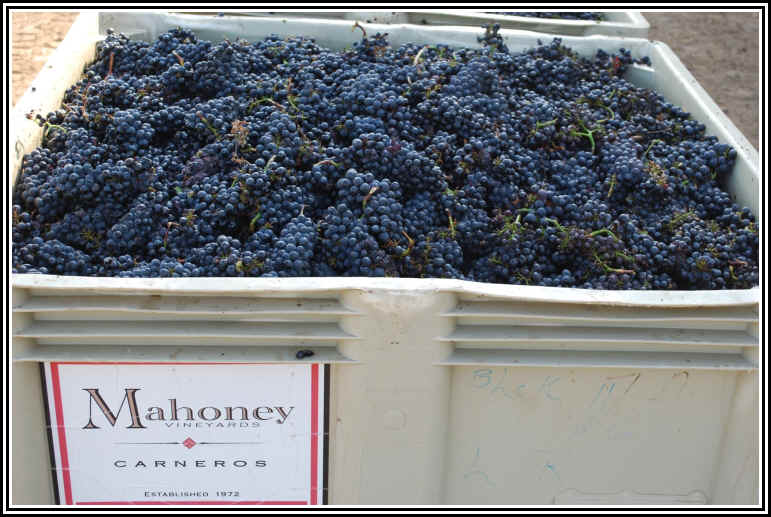
MAHONEY VINEYARDS
- Back in the 1960s and 1970s there was a lovely wine emporium in San
Francisco, south of Market Street, called Connoisseur Wine Imports.
It was a cool, underground warehouse featuring European wines, especially
those from Bordeaux and Burgundy.
Francis Mahoney was working at that retail establishment and he developed
an appreciation for Burgundy as they routinely had a nice selection of
those as well as some cool German wines.
With backing from the management of Connoisseur Wines, he began planting
Pinot Noir vines in the Carneros region. But not simply a generic
Pinot Noir. Instead Mahoney worked with a viticulture specialist
from U.C. Davis named Curtis Alley. This fellow was interested in
clonal selection of various grape varieties and he assisted Mahoney in
populating a small vineyard with numerous clones of Pinot Noir.
The Carneros Creek winery was built in the early 1970s and made some good
wines, particularly Pinot Noir.
We also have fond memories of some Zinfandels from vineyards up in the
Sierra Foothills.
-

- The Carneros Creek Winery ran smoothly into the late 1990s when Mahoney
sold the brand to an investment guy who held it for some years.
Eventually the Carneros Creek winery was purchased by Michael Mondavi and
that facility is used for some of their brands.
Mahoney retained vineyard holdings and has a new winery where he makes
several brands of wines, including his Mahoney label. Actually, the
winemaker is a fellow named Ken Foster who had made wine at the Santa Cruz
Mountains winery of David Bruce.
-
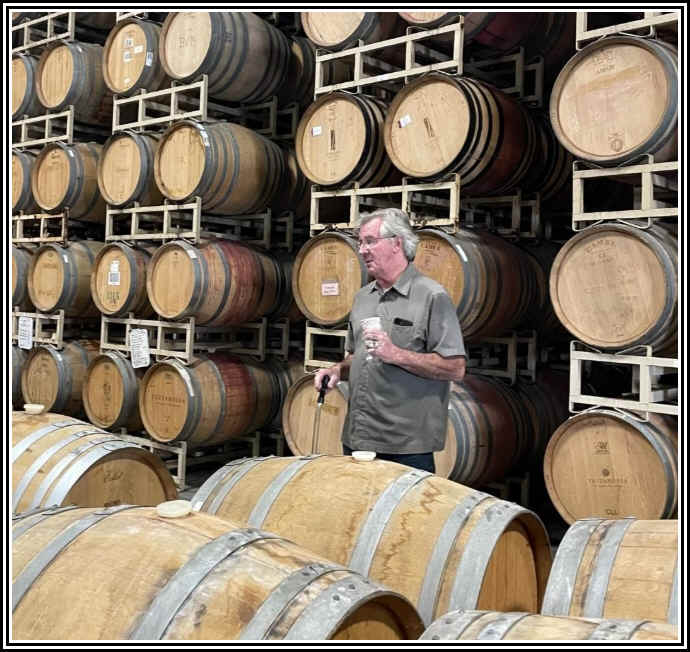
Winemaker Ken Foster.
-
We currently have a terrific 2022 vintage Pinot Noir from Mahoney...The
fruit comes from two vineyard sites owned by the winery: Mahoney
Ranch and their Las Brisas on the Sonoma side of the Carneros region.
It's comprised on numerous Pinot Noir clones, apparently contributing to
its complexity, including the shy-bearing Swan clone. The wine spent
about 16 months in French oak, with 50% of the barrels being brand new.
We like the classic dark cherry, red fruit notes of the Pinot Noir and the
wood adds a sweet tone to the bouquet and flavor of the wine.
It's quite drinkable presently and should remain n good condition for
another year, two or three.
By the way, they also make a delightful dry white from the Vermentino
grape. It seems Mr. and Mrs. Mahoney had visited her relatives in
Italy's Liguria and took a liking to that Italian wine. He's planted
a dozen acres of it and mostly sells the fruit, while making about 120
cases annually under the Mahoney label.
-
-
Currently in stock: MAHONEY 2022 CARNEROS PINOT
NOIR $24.99
- MORE PINOT
NOIRS
|


Sign.jpg)