Food, Wine & Friends Page 306
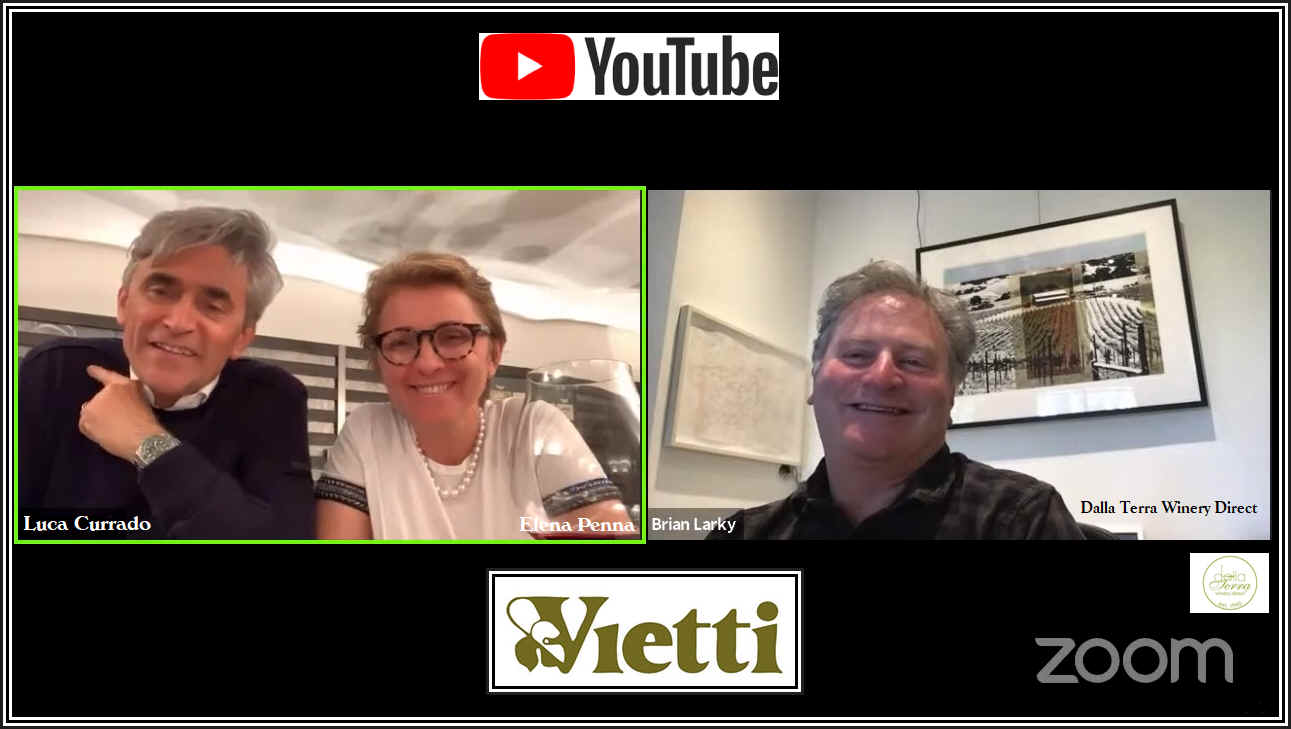
During the Spring of 2021 we were able to taste a few 2017 single vineyard
Barolo wines from the esteemed Vietti winery in Italy's Piemonte region.
Typically we visit Italy in April and taste hundreds of new wines from Piemonte
and other areas.
But with the Covid-19 Pandemic and travel being restricted in an effort to get
us back to some semblance of normal, we were unable to go.
And vintners such as Luca Currado and Elena Penna are unable to travel as well.
So some sample bottles were prepared and shipped to their US importer, Dalla
Terra.
And importatore Brian Larky orchestrated a Zoom event where store &
restaurant buyers could taste these 2017s and hear the story of the vintage and
the vineyards as told by Luca and Elena.
This was taking place at a time when we could not participate, but fortunately
the program was recorded and it's posted on YouTube.
If you'd like to have a look, here's the link:
CLICK
HERE
So we organized our tasting after work
later in the week and invited Kelvin DeBoer, a "field sales manager"
at Vietti's local distributor, Chambers & Chambers.
And on a warm, summer-like day in spring, we opened some bottles and viewed the
seminar.


We opened not only the 2017s, but wanted to share an older
vintage of a single-vineyard wine, so we decanted a bottle of the 2007
"Brunate" Barolo.


Visiting Italy in the 1980s we noticed a number of Langhe
vintners would decant some wines into a less-fancy decanter than people put on
tables these days.
So we ventured into Alba one day in 1984 (I think) and acquired a few of these.
And you know, this has ample surface area, allowing the wine to
"breathe" and you can pour wine without getting fingerprints on the
decanter.


And so we logged on to the video web site.

Luca Currado's family has owned the Vietti winery for many generations, though
it was acquired by an American family a few years ago.
This was a controversial move and criticized by some, but it has afforded Vietti
the possibility of increasing its vineyard holdings in many prime sites.
CLICK
HERE TO SEE VIETTI'S NOTES ABOUT THE 2017 HARVEST
One of the themes of this flight of single-vineyard wines which was repeated
several times concerned the notion winemakers love to talk about:
Terroir
This is the idea that wine can sometimes express a "sense of
place."
We have found, for example, some wines from eastern France display
characteristics unique to the region of Alsace.
We enjoyed a very modestly-priced Petit Chablis recently and the wine was an
exceptional example of Chardonnay grown in Chablis, France.
It could only have come from Chablis.
Sometimes warm vintages in Bordeaux, for example, can obscure the "sense of
place" as to the wine originating in Bordeaux. We find some ripe
years in Bordeaux are more reminiscent of Napa Valley Cabernet or Merlot than of
Pauillac or Pomerol.
If you taste wines of a particular winery and a particular site, you may have a
"vinous memory" of what to expect before opening the bottle.
One feature of wine appreciation is to note the characteristics of wines and how
the growing season (or vintage) impacted the wine.
Every year is unique and yet there is always a penchant for aficionados to want
to liken one year to another.
It's partly how wine marketing people sell a vintage, by comparing and
contrasting the just-released wine to previously successful years.
Ages ago one of the ways wine fans bought wine was by using a "Vintage
Chart" which could help one avoid a year where disaster struck.
We can think of the wines of Bordeaux, for example, where 1963, 1965 and 1968
produced really weak wines.
A Vintage Chart, guiding you to wines from stronger vintages such as 1961 or
1966 was helpful.
But as there has been a stretch where entire harvests in Bordeaux (or here in
Piemonte) have not been washed out, the vintage variations, while noticeable,
are not as extreme as they had been decades ago.
Some people considered 2014 a "weak" vintage for Piemonte, but there
were many top-flight Barbaresco wines, for one thing.
For another, top winemakers with well-placed, well-cultivated vineyards made
good Barolo wines in 2014. Those with vineyards in less-than-ideal sites
had trouble in 2014.
Once those wines have had ten years of bottle aging, people will taste them and
remark how good the wines are, "especially since they're from a bad
vintage."
The 2015s were considered more reliably good and with the 2016 vintage, if you
did not make a good wine, perhaps you should simply grow hazelnuts (a prominent
agricultural crop in Piemonte).
With the 2017 vintage, Mother Nature threw some curve balls at growers.
It's likely to be a vintage where one can identify those with experience and
expertise as opposed to those who simply shrug their shoulders and say
"whatever."

We tasted four single vineyard wines from Vietti's 2017
harvest and each spoke eloquently of the vintage, but even more fascinating,
each displayed individual characteristics typical of where they are grown.
That "sense of place" was thrilling to encounter.
Finding and noting the individuality of each bottling takes a bit of patience.
We opened the bottles maybe 30 to 40 minutes before sitting down to evaluate
them.
Freshly poured, you likely would not be able to easily differentiate one from
another.
But with an hour, or so, to swirl these in the glass and watch them "open
up" and evolve, the elements passionate vintners such as Luca and Elena
speak about were displayed with greater clarity.

We created a tasting sheet (above) and then listened to the seminar while
swirling and sniffing the wines.
CLICK HERE
TO CAPTURE THIS TASTING SHEET
Here's a link to a nicely detailed map of the various vineyard
sites in the towns comprising Barolo:
CLICK HERE

BRUNATE
On the detailed map of Barolo, look for the yellow-highlighted
vineyards of Brunate which are primarily in La Morra, bordered by the town of
Barolo.
Clear in appearance and slightly darker in color than the other samples
with a medium+ garnet hue, this wine was quick out of the gate in terms of aroma
and bouquet.
The nose was exceptional showing dark plum-like fruit and a touch of raspberry,
backed with hints of sweet spices.
Ellen wondered if part of this wine's immediate charm might be due to a fraction
of the wine having spent time in small barriques as opposed to solely being in botte
grande (big wooden vats).
Luca and Elena spoke of the immediate drinkability of the Brunate Barolo,
saying, for them, it was not especially tannic or astringent.
This illustrates their having a higher threshold for tannin than an average wine
consumer. If you are tasting young (and even older) Barolo on a regular
basis you likely become less sensitive to the astringency in such a wine.
We felt this was moderately tannic and grippy on the palate, finding this to
have perhaps 10 to 25 years of cellaring potential.
Compared to the three other wines, why yes!, this is "softer" and more
approachable.
It was remarkably good at this stage and promises to be a magnificent wine with
proper cellaring and patience.
We often note that wines with more tannin or those that are perceived to have
longer aging potential earn additional accolades from those experts who seem to
be able to differentiate wines using a 100 Point Scoring System.
Keep that in mind if you follow such experts. Your own mileage may vary.
RAVERA
On the map of Barolo, look to the southwest town of Novello...the
light green-colored area almost due south of the town of Barolo.
There you will find Novello's Ravera cru (not to be confused with a Ravera
vineyard in nearby Monforte d'Alba).
This cru is a bit of a new-comer in terms of prestige and
interest. It's a site which has been a highlight in the portfolio of the
Elvio Cogno winery, which sits surrounded by Ravera vineyards. Vietti has
been offering a Ravera bottling of Barolo since the 2010 vintage and it's a
difficult wine to assess in its youth (and we don't have experience with old
vintages of mature Vietti Ravera Barolo, of course).
Luca Currado cites a run of warmer growing seasons as a key factor in elevating
this cru to upper echelon status, but keep in mind that the owners of Cogno (the
late Elvio Cogno's daughter Nadia and her husband Valter Fissore) are close
friends of the Vietti crew. Both teams are astute students of Barolo
winemaking and they work tirelessly in the vineyards.
Given this site is a slightly cooler area, it displays firm acidity which
contributes to the wine's strength and longevity.
Medium garnet in color with pretty red fruit fragrances and a faintly woodsy,
balsamic note, this is an acidic and tannic Barolo. It's a bit
muscle-bound presently, being lean and astringent with hints of a floral
tone. As it got some air, I detected a faint note of mocha. It's a
wine demanding bottle aging and this vintage will likely achieve a satisfying
level of complexity by 2030, or so and should be capable of cellaring well to
the middle of this century.
To drink in the short term? No!

LAZZARITO
Look to the eastern part of the map for the town of Serralunga...the
beige highlighted portion of the map is the esteemed Lazzarito cru.
Vietti, we believe, has been offering a Lazzarito bottling of Barolo since
the 1989 vintage. This Serralunga cru is noted for its
cellar-worthy structure and it's a wine for those who have a good cellar as well
as patience to wait for this to develop.
Medium garnet in color and clear in appearance, we encountered mild cherry-like
notes and other red fruit fragrances. With airing this opened up
handsomely, starting out quite shy and closed. It blossomed beautifully
over the course of the tasting with a suggestion of a spice note and maybe a
cigar-like tobacco element. This is quite tight and tannic, which we'd
estimate will really shine in the mid-2030s through the middle of the 21st
century.
Presently, though, the uninitiated might wonder why expert tasters recommend
such a wine.
Be patient and you will see!
ROCCHE DI CASTIGLIONE
If you can locate Castiglione Falletto near the center of the Barolo
map, there's a small thin band noted in light brown highlighting Rocche di
Castiglione (so noted to distinguish it from "Rocche" bottlings from
the La Morra area).
Vietti has been making wine from the Rocche cru for maybe 60 years
now. We identify this winery with the Rocche cru.
Some of the vines are now quite elderly, the oldest having been planted in 1940
and 1950.
The wine is clear in appearance and medium garnet in color. There's a
prominent fragrance to this which we initially described as eucalyptus.
Some tasters may interpret this as menthol, but it's in the direction of a sort
of resiny character. We found plenty of red fruit here, too, with a hint
of a tobacco quality.
Another distinctive feature of the 2017 Rocche is an element which we likened to
profound red Burgundy.
We can imagine a vigneron in Morey-Saint-Denis or Vosne-Romanée finding a soul mate
here. It's quite deep and has plenty of finesse and backbone. Its
balance is a bit deceiving as the the tannin seems well-integrated with the
fruit and that eucalyptus/menthol character, but we suspect this will age
handsomely from 2030 into the 2050s.
After tasting these terrific wines, we fired up the stove and
prepared some vittles to accompany more vino.


And we had some mushrooms...


Soon we were ready to serve some Risotto...


The 2019 Arneis from Vietti was a beautifully crisp, dry white...no oak.
And the 2007 Barolo Brunate from Vietti was "off the charts" good.


For the main plate...

Ellen is not a fan of Lamb, so we had a Salmon serving for her...in parchment
paper with Zucchini and Tomatoes.

Some side dishes...


The 2007 Brunate was exceptionally good.
The bouquet was amazingly complex with some floral and truffle-like notes with
plenty of red fruits.
It was beautifully developed on the palate, moderately tannic and yet remarkably
well-balanced. The lamb took the edge off the Barolo and the combination
was exceptional.
We had hoped the wine would show handsomely and it was even better than
expectations (which were high).
When you taste a bottle of wine in a particular setting and it is monumentally
good, you'll question those who gave it anything less than a perfect, 100 point
score.
And you may realize that while a good score is nice praise for the winemaker or
winery, each bottle presents its own unique experience.
****************************
Kelvin's wife Leslie sent a little dessert along with him.
(She was trying to get him out of having to do the dishes, apparently.)


Then we made some Espresso.
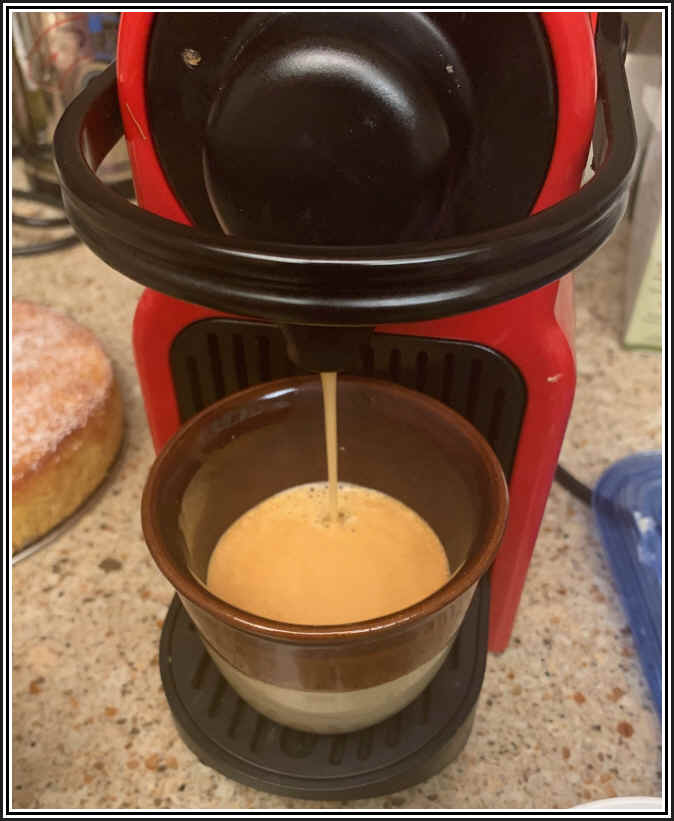
And poured it over some homemade Pistachio Gelato!

Many thanks to Luca and Elena for sending those Barolo campione!
We created a new Vietti Apron, by the way.

It's got the Brunate label design on it with the notation of the VIETTI FAN CLUB
and then our shop name below the label.
CLICK
HERE TO BUY ONE
BACK TO THE
FIRST FOOD, WINE & FRIENDS PAGE
BACK
TO THE PREVIOUS PAGE
ON TO THE NEXT PAGE


